
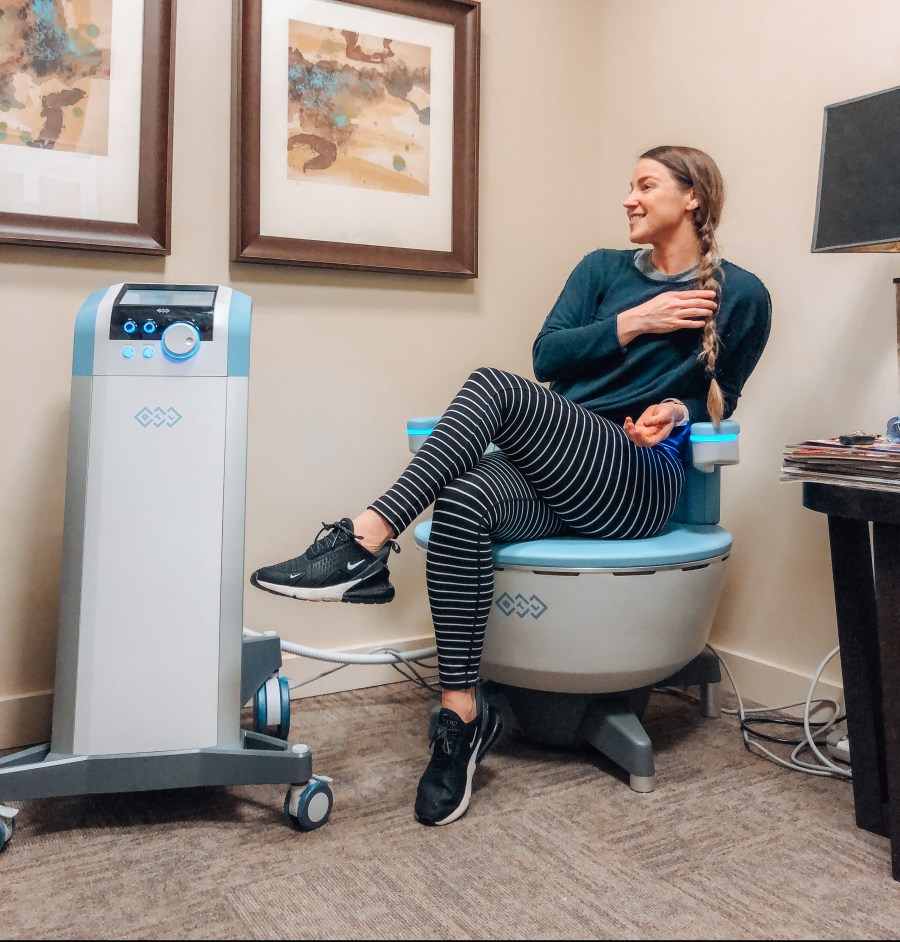
So here we are. I’m almost 9 months postpartum. Right after Logan was born, I was very adamant about doing postpartum PT for diastasis recti and pelvic floor health. I had a long labor with Logan and knew that all of this would be really important longterm because of how active I am.
After going to PT twice a week for three months, I felt some improvement. I also felt pretty confident in doing the PT exercises at home and building on them. At this point, my DR was nearly healed but my pelvic floor still needed strengthing. Although I could now run comfortably for many miles, I still was having issues with things like jumping jacks, box jumps and basically anything high impact. If you know me, you know that I love boutique fitness and workout classes so correcting my pelvic floor weakness began to be really important to me!
One estimate I read stated, 35 percent of new mothers experience urinary incontinence following childbirth and 20 percent of first-time moms experience severe pelvic floor muscle injury after a normal pregnancy and delivery. These numbers seem low to be honest. After talking with many new moms, pelvic floor weakness seems to be fairly common just not something widely talked about. If you cross your legs when you sneeze, you know what I’m talking about!
Intro Emsella™. Emsella Technology has been cleared by the FDA for non-invasive treatment of stress incontinence for women. Clinical research studies have also found it effective for overactive bladder symptoms, sexual issues, and prevention + improvement of pelvic floor weakness.
Emsella technology uses electromagnetic waves to generate effective whole-pelvic-floor Kegel-type contractions. The patented technology also uses muscle relaxation cycles to eliminate lactic acid accumulation, thus avoiding discomfort and soreness. Women and men who complete a painless (fully clothed) 28-minute treatment cycle can immediately resume all regular activities. That’s right, the treatment is non-invasive, totally painless and has zero downtime.
The muscular improvement of the pelvic floor muscles is accompanied by improved physiology. Most patients do 6 sessions, performed over 3 weeks. Some individuals will not need follow up therapy, while others may want to have follow-up treatments every 3-6 months.
Wanting to give Emsella a chance, I teamed up with Monarch Plastic Surgery in Leawood, KS. I’ve been to the center before for skincare procedures and have always loved their staff. After learning more about me and my goals, we decided to do 6 treatments, twice a week for three weeks.
During the treatment, I felt no pain but I did feel the electromagnetic contractions. I’ve done a lot of marathon recovery in my days and the sensation felt a lot like using a TENS unit only I was sitting in a chair without any cords attached to me. The machine rotated between longer contractions and quick flicks (shorter contractions). The aestheticians told me that one Emsella treatment is like doing close to 11,000 kegels. THAT’S A LOT OF KEGELS.
For me personally, things got worse before they got better, which I was warned about. Like any other muscle in the body, our pelvic floor can get fatigued if worked frequently. And 20k kegels in one week will do that to a girl. So essentially halfway through my treatment cycle, I had some fatigue and leakage during my workouts.
I’m now almost two weeks post-treatment and I have to say that I’m happy with my results. It is difficult to achieve 100 percent effectiveness for any treatment, but over 90 percent of clients have significant improvement. This is true in my case. I still have trouble sneezing if my bladder is very full but I now can do jumping jacks, and more high impact movements with much better control. I’ve even noticed less frequent bathroom breaks in the night — especially if I limit my water intake before bed.
I feel like this is the perfect time to do this procedure because I’m currently weening now that Logan is 9 months old. (She has plenty of breastmilk in the freezer!) The prolactin in my body should start to fade over the next month. Prolactin is what triggers the body to make breastmilk but it also makes your muscles and joints “soft” and more relaxed. As my prolactin levels drop, I hope that things start to feel more “normal” in my body.
If you’re thinking about doing Emsella, I recommend two things … an eval with your PT or doctor/OBGYN to see exactly what you’re dealing with and then a consultation discussing Emsella to see if it’s right for you. Some women experience pelvic prolapse after birth and in that case, a custom designed combination therapy is often prescribed.
So would I recommend Emsella to a friend? Yes, if it’s a good fit. I personally was spending $40 in co-pay per PT session twice a week. That’s basically $300 a month. A few months of PT cost me roughly a thousand dollars. So rather than doing more PT, I took what I learned and built on that at home and combined it with the Emsella treatment to get results I’m happy to share about.
While Emsella is FDA approved, it is not currently covered by insurance as more scientific studies are needed but it’s a great option none-the-less. Have you tried Emsella? I’d love to hear your experience in the comment section below.
Location: Monarch Plastic Surgery
Aesthetician: Erika W.
 Sweat Adventures